Inattentional blindness: Why we miss what’s right in front of us
Inattentional blindness is our tendency to miss something clearly visible because our attention is focused somewhere else. The famous Invisible Gorilla experiment showed how dramatically this can happen: people concentrating on counting basketball passes often failed to notice a person in a gorilla suit walking through the scene. The lesson goes well beyond psychology. What we focus on shapes what we notice — and sometimes the thing we're looking for stops us seeing what was there all along.

The invisible gorilla
Count the passes
In 1999, psychologists Daniel Simons and Christopher Chabris conducted what became one of the most famous experiments in psychology.
They showed people a short video of two teams passing basketballs and gave them one simple task:
Count the number of passes made by the players wearing white.
Before reading any further, watch the video and try it yourself.

Did you see the gorilla?
About half the people watching don’t.
Which is fucking extraordinary when you think about it.
A person dressed as a gorilla walks into the middle of the game, turns towards the camera, thumps their chest and walks off.
They’re on screen for about nine seconds.
And people don’t see them.
Their eyes work perfectly.
They’re looking straight at the screen.
But their attention is somewhere else.
It’s called inattentional blindness.

We see what we’re looking for
Attention isn’t a camera recording everything in front of us.
It’s more like a spotlight.
Whatever we point it at becomes incredibly clear. Everything outside it becomes easier to miss.
That’s incredibly useful. Imagine trying to consciously process every sound, movement, face, colour, object and sensation around you simultaneously. We’d get absolutely nothing done.
So we focus. But focus has a price.
When we pay attention to one thing, we become less available to everything else.
And that’s where the gorilla gets interesting.
Because life is full of invisible gorillas.
🦍 The thing you already had while you were busy wanting something else.
🦍 The door that opened while you were busy banging on another one.
🦍 The answer you already knew while you were asking everyone else.
🦍 The person worth knowing while you were looking for someone more important.
The problem is, we rarely know what we’re missing while we’re missing it.
That’s what makes it invisible.

Focus doesn’t only help us see. It can stop us seeing.
We spend a lot of time talking about focus as though more focus is always better.
Focus on the goal. Focus on the plan. Focus on the target. Focus on the KPI. Focus. Focus. Focus.
And obviously focus matters. But the Invisible Gorilla experiment exposes the other side of it.
Every act of attention is also an act of exclusion.
When you decide what matters, you’re also deciding — consciously or otherwise — what you’re going to pay less attention to.
That matters in organisations. A business obsessed with this quarter’s numbers can miss what’s happening to its culture. A leader focused entirely on performance can miss the person who’s quietly falling apart. A company watching its competitors can miss something completely different emerging from somewhere it wasn’t looking.
And it matters in life.
You can become so focused on getting somewhere that you don’t notice where you already are.
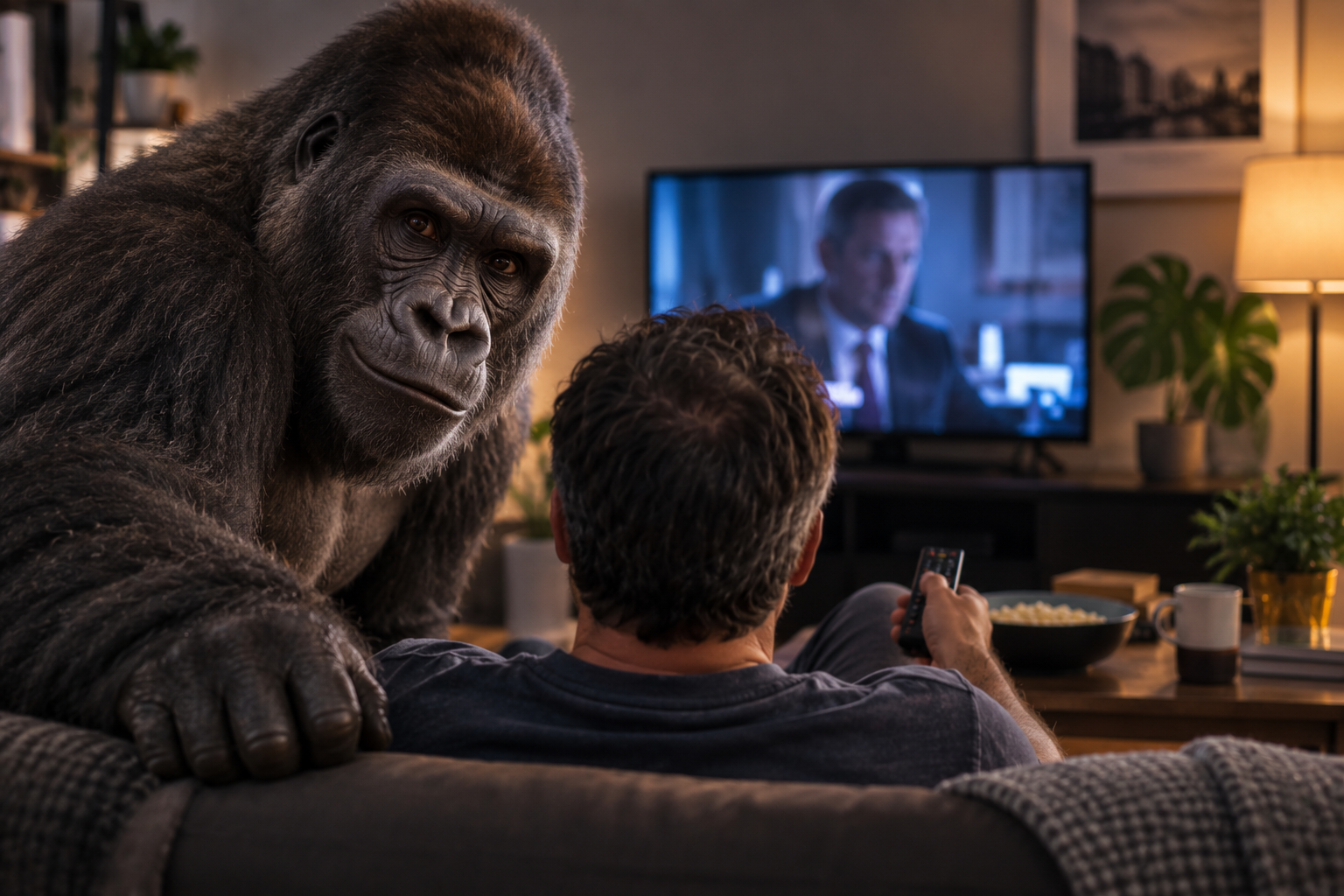
What are you counting?
Just like the Invisible Gorilla video, we spend our lives counting passes.
Deadlines. Money. Meetings. Messages. Problems. Followers. Targets.
The next thing that needs doing. The next thing we want. The next thing we think will finally make everything better.
And when you’re busy counting things, it’s very easy to miss things.
Something really important could be standing right in the middle of your frame.
Totally invisible.
Not because it isn’t there. Because you’re looking for something else.
What are you not seeing?
This is part of the territory I explore in The Real YOU: how the way we see ourselves and the world around us shapes how we behave — and what happens next.