How does product reputation affect brand reputation? The Johnson & Johnson paradox
A product’s reputation can become part of the reputation of the company behind it, particularly when that product becomes an iconic expression of the brand itself. Johnson’s Baby Powder spent more than a century accumulating associations of trust, purity and care. That made it an extraordinary brand asset. But when the product became the centre of cancer allegations and massive litigation, the same connection created reputational risk. Brand meaning flows both ways.
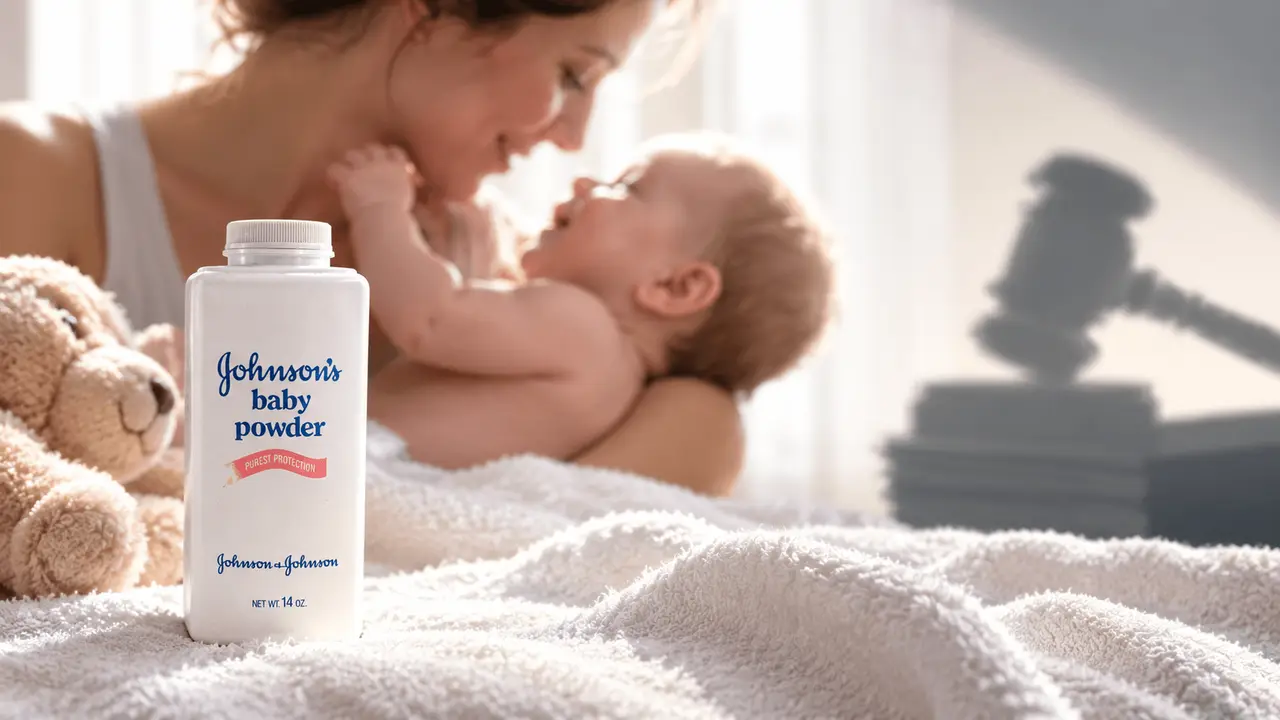
J&J’s brand in a bottle
I used to work on Johnson & Johnson.
And if there was one product that captured everything the brand stood for, it was Johnson’s Baby Powder.
Baby Powder wasn’t another J&J SKU.
Johnson’s Baby Powder was almost Johnson & Johnson in product form.
Baby. Mother. Touch. Softness. Purity. Trust. Care.
It had been around since 1894. Generations of parents used it on their children. Even the smell became part of the brand. You could smell baby powder and know what it was without seeing the packaging.
That’s what happens when a product becomes iconic.
It stops being something a company sells.
It starts carrying the meaning of the company itself.
And that can be incredibly powerful, until something goes wrong.
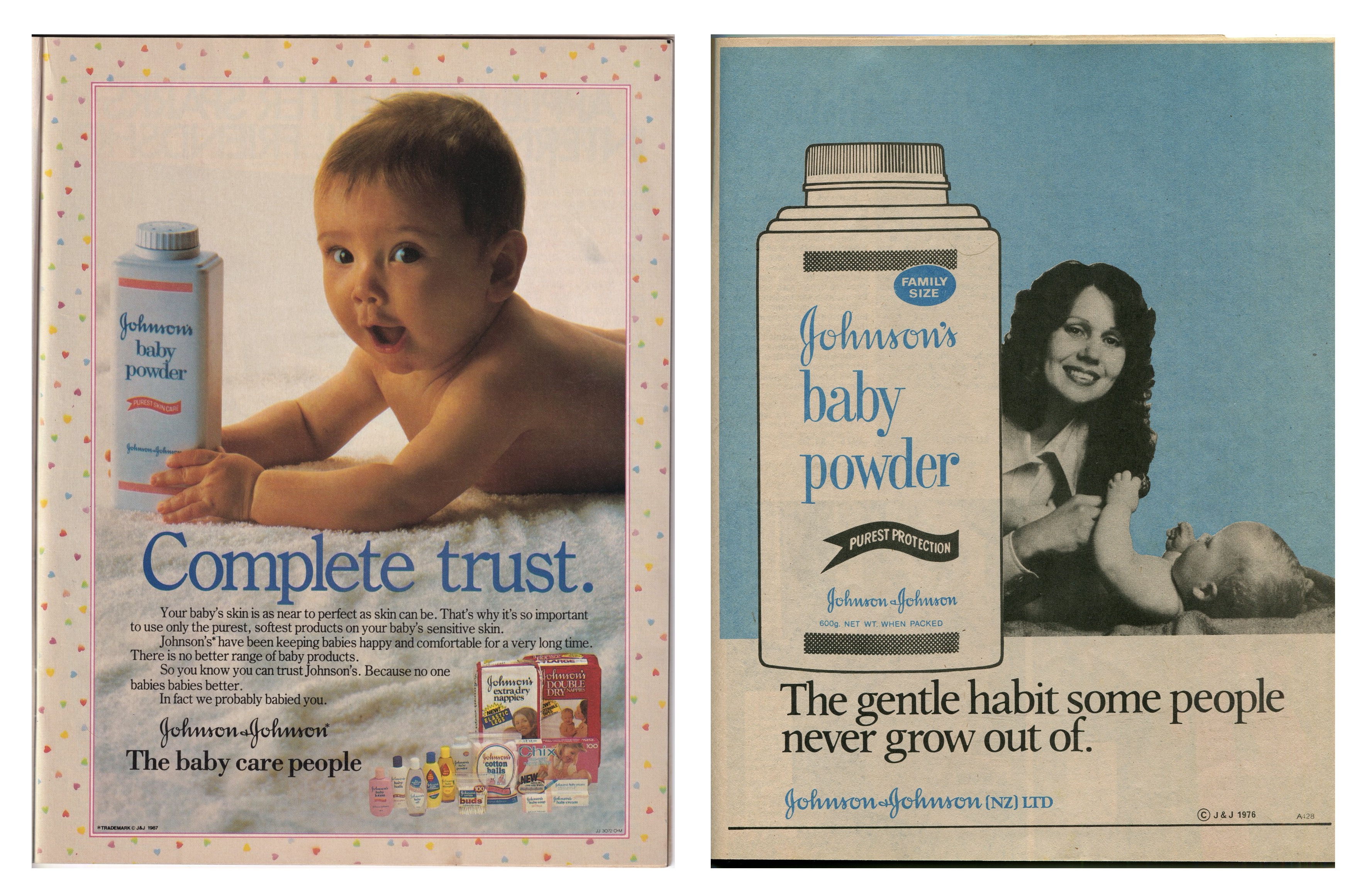
Then the product became the problem.
Traditional Johnson’s Baby Powder was made with cosmetic talc.
Talc is a naturally occurring mineral, and talc deposits can occur close to asbestos deposits. The litigation surrounding J&J has involved allegations that talc products were contaminated with asbestos and caused cancers including mesothelioma, as well as claims concerning ovarian cancer associated with long-term talcum powder use.
J&J has consistently maintained that its cosmetic talc was safe, asbestos-free and did not cause cancer. In 2022, the company announced it would discontinue talc-based Johnson’s Baby Powder globally in 2023 and transition to an all-cornstarch portfolio. And the legal battle has been enormous.
In July 2026, Johnson & Johnson announced a proposed US$5.5 billion agreement intended to resolve roughly 76,000 remaining ovarian talc claims, subject to at least 95% claimant participation and other conditions. J&J continues to maintain that the claims are without merit.
Here in Australia, a class action is also progressing. Its first case-management conference was scheduled for 26 August 2026.
Now think about the brand problem this creates.
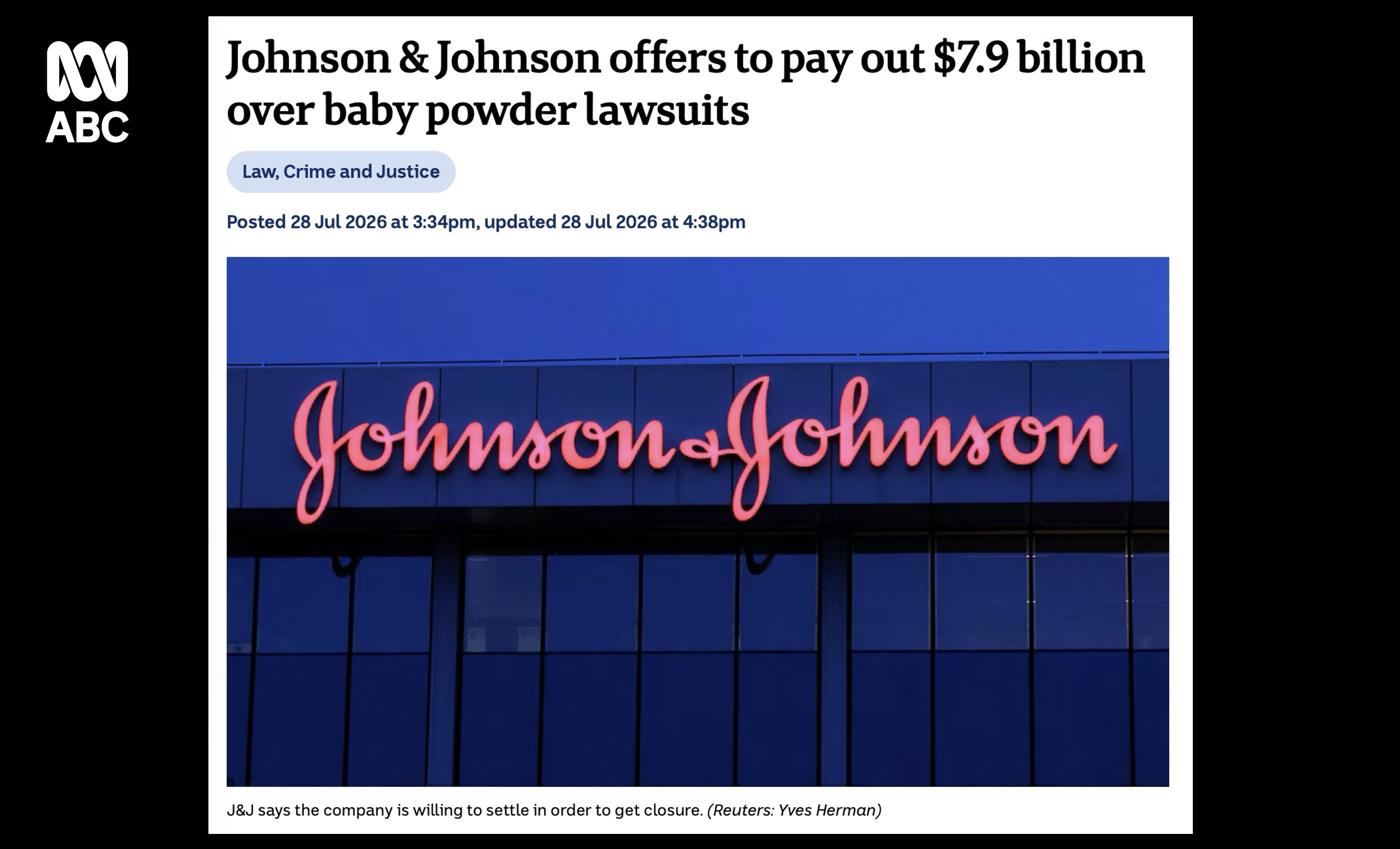
Who would have thought?!
For more than a century, Johnson’s Baby Powder accumulated meaning.
Every mother who used it. Every baby who smelled of it. Every memory associated with that familiar white bottle. Every one added another tiny deposit of trust to the Johnson & Johnson brand.
That is how brands are built. Through experience, association and memory. And Johnson’s Baby Powder had more than a century of them. Which is why what happened next is so interesting.
The product that arguably represented trust and care more powerfully than anything else associated with J&J became the centre of one of the largest product-liability battles imaginable.
When the product most closely associated with your values becomes the product at the centre of the controversy, you have a very unusual kind of brand problem.
Because the meaning flows both ways.
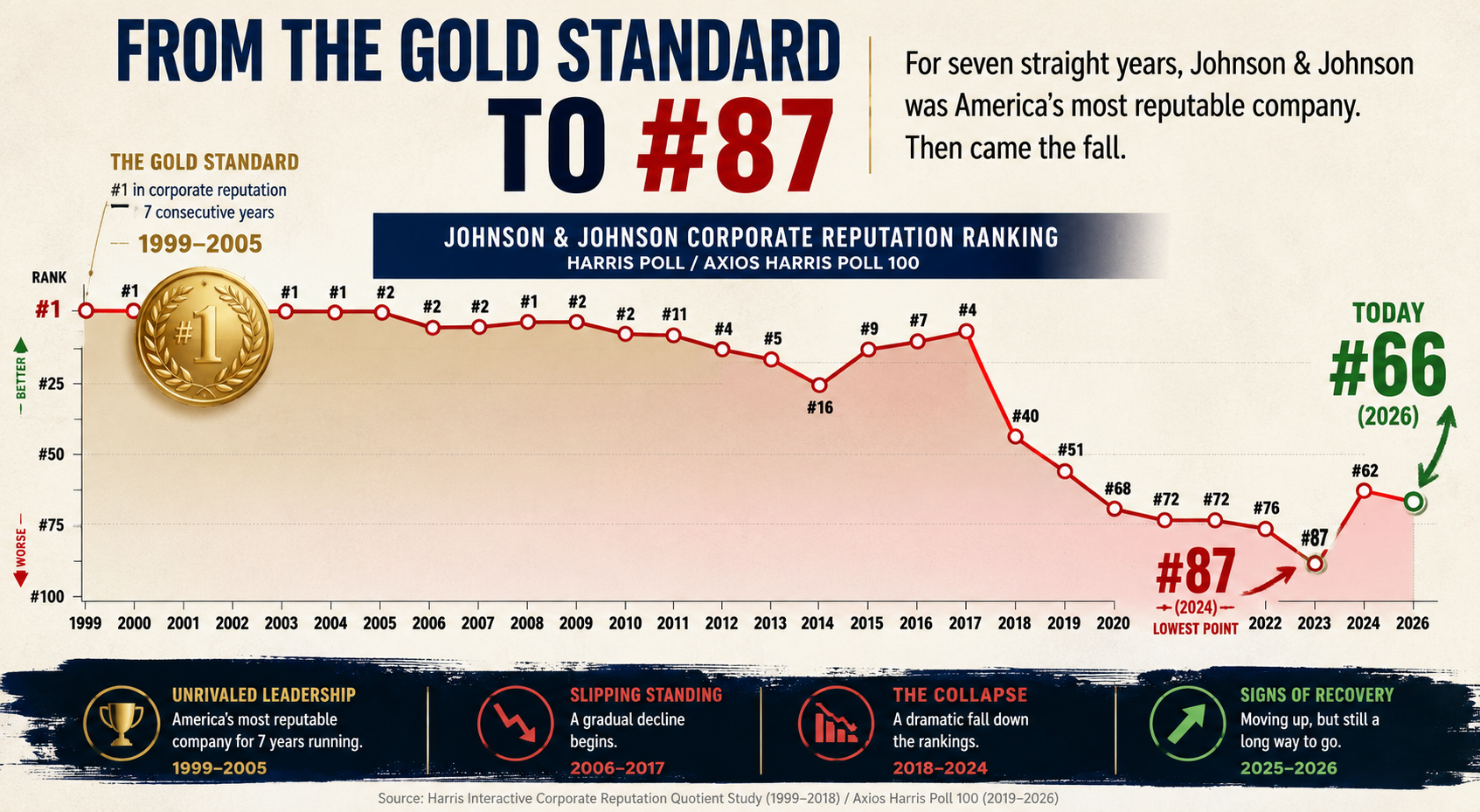
FROM #1 TO #73
When Harris Interactive conducted its first major corporate reputation study in America in 1999, Johnson & Johnson ranked #1. And it stayed there.
By 2005, J&J had been ranked #1 for seven consecutive years. Its reputation was assessed across areas including products and services, social responsibility, emotional appeal, workplace environment, financial performance, and vision and leadership. citeturn1search0turn1search5
Think about that. Seven years. The most highly regarded corporate reputation in America.
By 2024, Johnson & Johnson was #73 in the Axios Harris Poll 100. In 2025 it recovered to #62.
Now, you cannot attribute that decline to Baby Powder alone. J&J is an enormous global company with a long and complicated history. Its reputation has been affected by many things, and the Axios Harris methodology itself has evolved over time.
So I’m not drawing a neat little straight line between Baby Powder litigation and J&J falling down a reputation table. Life isn’t that convenient. But the contrast is still extraordinary.
A company that once represented the gold standard of corporate reputation no longer occupies anything like the position it once did. And the product that once embodied some of its most powerful positive associations has spent years at the centre of damaging allegations and litigation.
When your greatest brand asset becomes a liability
This is the double-edged sword of an iconic product.
We normally think of iconic products as enormous brand assets. The Coke bottle. The Nike swoosh on a pair of shoes. The Volkswagen Beetle. The Tiffany box. And, for generations, that little white bottle of Johnson’s Baby Powder.
Products like these become physical containers for brand meaning. They carry memory. Emotion. Trust. Identity. Sometimes nostalgia.
The stronger that connection becomes, the more valuable it is. But there’s another side to that equation.
If the product carries the brand’s meaning when things are good, it carries the brand’s meaning when things go bad.
You don’t get to have the association in only one direction. That is what makes iconic products so powerful, and potentially so dangerous.
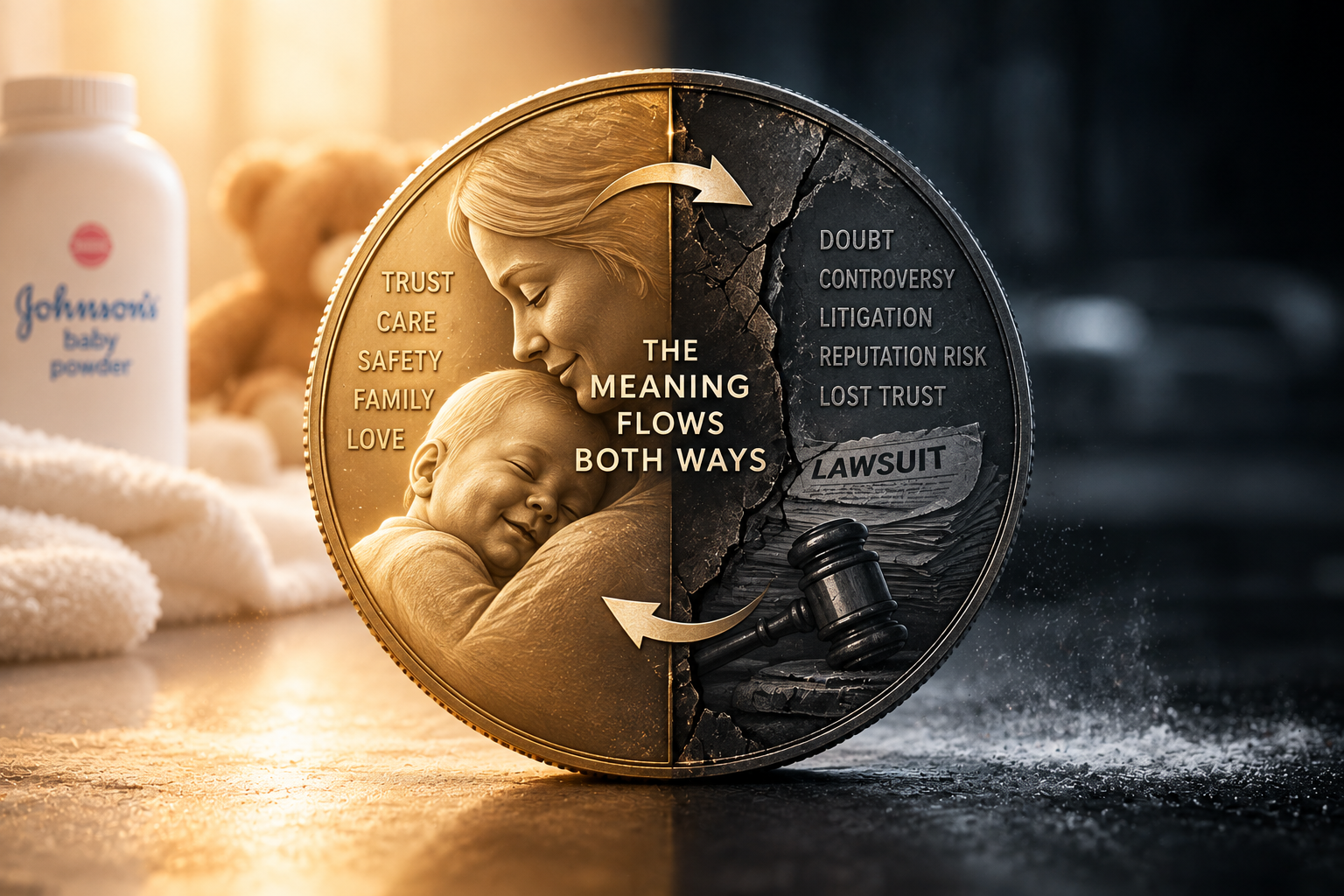
The meaning flows both ways
Brand isn’t what you say about yourself. It’s what people come to associate with you.
And those associations are built through everything people experience: your products, your people, your behaviour, your decisions and what happens when something goes wrong.
For more than a century, Baby Powder helped put meaning into Johnson & Johnson. Trust. Care. Safety. Motherhood. Family. Then the relationship reversed.
The controversy surrounding Baby Powder began taking meaning out. That doesn’t mean one product explains the reputation of an entire global corporation. It means something more useful for anybody responsible for a brand:
The things that represent you most powerfully can affect you most powerfully.
That’s the deal. Brand meaning flows both ways.